Government College of Engineering, Kalahandi
ସରକାରୀ ଯାନ୍ତ୍ରିକ ମହାବିଦ୍ୟାଳୟ, କଳାହାଣ୍ଡି
(An Affiliated Institute Of BIJU PATNAIK UNIVERSITY OF TECHNOLOGY, ODISHA)
Government College of Engineering, Kalahandi
ସରକାରୀ ଯାନ୍ତ୍ରିକ ମହାବିଦ୍ୟାଳୟ, କଳାହାଣ୍ଡି
(An Affiliated Institute Of BIJU PATNAIK UNIVERSITY OF TECHNOLOGY, ODISHA)

Welcome to the Department of Electronics and Communication Engineering at GCE Kalahandi.
Electronics and Communication Engineering (ECE) graduates have access to diverse global opportunities, driving next-generation innovations like network architecture optimization for 5G and 6G technologies, semiconductor and VLSI design, development in IoT, robotics, and embedded systems. With the rigorous analytical training of an advanced curriculum, ECE graduates are highly versatile and can seamlessly transition into software sectors, automation industries, and high-impact research. Ultimately, an ECE degree equips students to lead technological advancements that drive both industrial progress and sustainable global solutions.
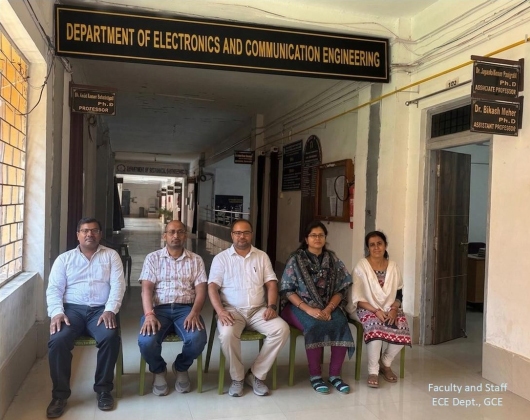
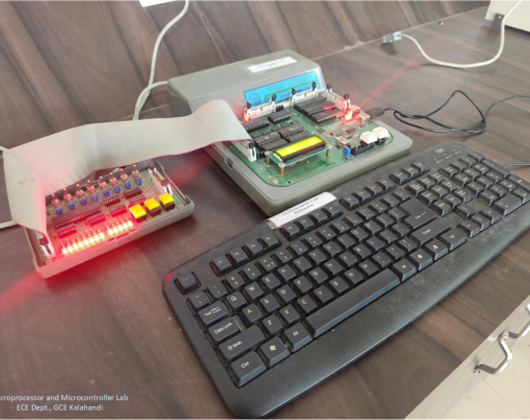
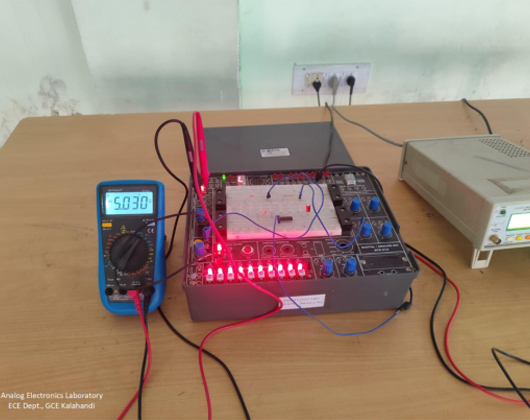
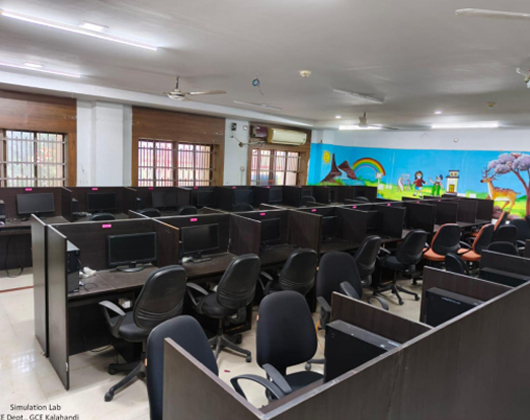
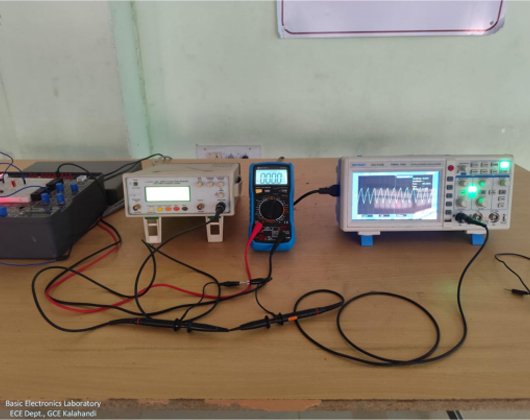
The ECE department at GCE Kalahandi is guided by a vision of achieving excellence in technical education and collaborative research. The department is strengthened by an advanced, industry-aligned academic framework developed under the Biju Patnaik University of Technology (BPUT). The department has state-of art laboratory facilities for core electronics experiments and in the process of establishing advanced laboratories. The department has a pool of highly qualified and deeply committed faculty members whose academic and research potential forms the backbone of our department. The faculty members have expertise in multiple specializations, including Communication and Signal Processing, VLSI and Embedded Systems, Artificial Intelligence and Machine Learning, and other emerging domains.
Vision
To achieve excellence in technological education and collaborative research in Electronics and Communication Engineering, producing globally competent professionals dedicated to the service of humanity
Mission
PEO 1: Graduates will build successful careers in electronics, communication, semiconductor design, and allied fields through strong technical and problem-solving skills.
PEO 2: Graduates will engage in research, innovation, and multidisciplinary partnerships with industry and academia to deliver sustainable engineering solutions.
PEO 3: Graduates will demonstrate leadership, professional ethics, and effective communication while pursuing higher education, entrepreneurship, and continuous learning.
PSO 1: Ability to analyze, design, and hardware-validate electronic circuits, embedded processors, and semiconductor devices using industry-standard EDA tools.
PSO 2: Capability to model, simulate, and implement advanced communication infrastructures, RF circuits, and signal processing protocols for modern networked applications.
PSO 3: Competence to integrate core electronics knowledge with modern tools to design sustainable, resource-efficient technological solutions that address industry needs and societal challenges.
| SL.NO. | Laboratory |
| 1 | Basic Electronics Lab |
| 2 | Analog Electronic Circuits Lab |
| 3 | Signals and Systems Lab |
| 4 | Digital Systems Design Lab |
| 5 | Principles of Communication Systems Lab |
| 6 | Microprocessor & Microcontroller Lab |
| 7 | Digital Signal Processing Lab |
| 8 | Digital Communication Techniques Lab |
| 9 | VLSI Design Laboratory |
| 10 | Project Lab/ Tinkering Lab |

Dr. Jayanta Kumar Panigrahi
HOD & Associate Professor
BE, M.Tech, Ph.D. (NIT, Rourkela)
Departments